
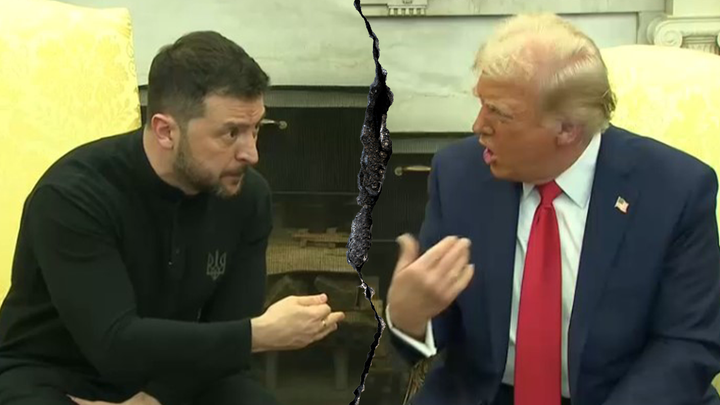
The recent Oval Office confrontation between President Donald Trump and Ukrainian President Volodymyr Zelenskyy has sent shockwaves through global politics. What should have been a crucial diplomatic meeting turned into a heated exchange, raising questions about Ukraine’s future, the U.S.’s role in the conflict, and the broader geopolitical landscape.
This isn’t just another political dispute—it’s a moment of reckoning. Let’s break down the key takeaways from this diplomatic disaster and explore what it means for Ukraine, the U.S., and the ever-shifting balance of power.
1. Zelenskyy’s Miscalculated Allies
Zelenskyy appears to be relying on allies who are either unwilling or unable to deliver the support he needs. While he has courted Western progressives and European leaders, the reality is that those with the most influence in 2025—Trump and his administration—are the very people he seems most at odds with. His miscalculation could cost Ukraine dearly.
2. The U.S. and Ukraine: A Shared Interest, But Not a Shared Agenda
Zelenskyy often frames Ukraine’s fight as a global battle for democracy, implying that U.S. interests are directly tied to Ukraine’s survival. But Trump’s foreign policy priorities suggest otherwise. He wants to de-escalate tensions with Russia and focus on China as the primary geopolitical adversary. If Ukraine’s goals don’t align with this vision, support from Washington may dwindle.
3. Europe’s Talk of Independence Rings Hollow
European leaders have made grand promises about strengthening their own defense capabilities and reducing reliance on the U.S. But doing so would require them to invest heavily in their militaries, rethink their energy strategies, and abandon costly social programs—moves that seem unlikely. Without U.S. backing, Ukraine may find European support to be largely rhetorical.
4. The Reality of a Peace Deal
Ukraine is heavily armed but still outside NATO, and no U.S. administration is likely to provide enough military support for Kyiv to retake Russian-occupied territories. If a peace deal is inevitable, the key questions are: How much land will Putin keep? And what guarantees can deter future Russian aggression? A Korea-style demilitarized zone, backed by Western investments, may be the best-case scenario.
5. Zelenskyy’s Limited Options
If the U.S. scales back support, what are Ukraine’s alternatives? Hope for a Democratic White House in four years? Wait for Europe to step up militarily? Pray for another Trump impeachment? None of these seem like viable strategies. Instead, Zelenskyy may need to swallow his pride, re-engage with Trump, and secure a deal that ensures Ukraine’s long-term security and economic viability.
6. Elections and Transparency: The Uncomfortable Question
If peace talks move forward and Ukraine receives more Western investment, will there be democratic elections? And if so, would Zelenskyy win? More importantly, would a transparent government reveal where billions in foreign aid have actually gone? These are questions that Western allies may soon start pressing harder.
7. Learning from Netanyahu’s Playbook
Israeli Prime Minister Benjamin Netanyahu has managed to navigate a difficult relationship with the U.S. without alienating his most critical ally. Even when the Biden administration pressured Israel, Netanyahu remained strategic, avoiding public confrontations. Zelenskyy, by contrast, seems to have taken a more confrontational approach—one that may backfire when Ukraine needs U.S. support the most.
8. Without U.S. Backing, What’s Ukraine’s Endgame?
If Ukraine loses American support, what is the plan? Russia is regaining strength, and Europe is unlikely to fill the gap. Does Zelenskyy have a strategy, or is he gambling on the hope that geopolitical tides will turn in his favor? A failure to answer this question could prove disastrous.
9. The Diplomatic Misstep That Changed the Tone
Reports suggest that the Oval Office meeting was going well—until Zelenskyy started correcting Trump and Vice President JD Vance. His tone and gestures suggested he viewed Trump as just another Western leader willing to write blank checks. That assumption was not only incorrect but also deeply naive.
10. The Shift from 2022 to 2025: A Different Ukraine, A Different World
In 2022, Zelenskyy was a symbol of defiance, rallying the world behind Ukraine’s fight for survival. But three years, 1.5 million casualties, and shifting geopolitical realities later, the situation is starkly different. Ukraine is no longer the West’s favorite cause, and Zelenskyy himself faces growing scrutiny for postponing elections and cracking down on political opposition. The world has changed—has Ukraine’s leadership adapted?
Where Does Ukraine Go From Here?
Zelenskyy is at a crossroads. He can double down on defiance and risk losing crucial U.S. backing, or he can recalibrate, acknowledge geopolitical realities, and negotiate a deal that secures Ukraine’s long-term survival. The choice he makes in the coming months will shape not just Ukraine’s future, but the broader balance of power in Europe.
One thing is clear: the era of unquestioned Western support is over. What comes next is up to Zelenskyy.