
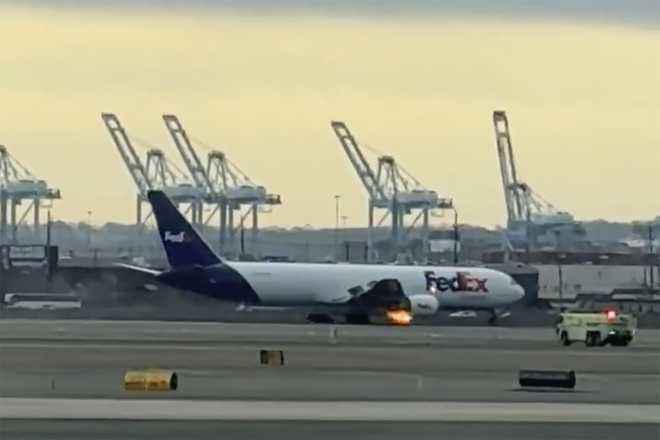
A FedEx cargo plane was forced to make an emergency landing at Newark Liberty International Airport after a bird strike caused an engine fire, sending flames into the morning sky. While no injuries were reported, the incident raises important questions about aviation safety, the increasing frequency of bird strikes, and how well-equipped the airline industry is to handle such emergencies.
Let’s break down what happened, what it means for flight safety, and whether the aviation industry is doing enough to prevent these potentially catastrophic events.
1. A Routine Flight Turns Into a High-Stakes Emergency
The FedEx flight, en route to Indianapolis, was just a few hundred feet off the ground when disaster struck. Audio from LiveATC captured the calm but urgent response from the cockpit: “We need to return to the airport.” Moments later, another transmission reported the unthinkable—witnesses believed they saw an engine fall off the right wing.
Despite the terrifying situation, the pilots managed to land safely, demonstrating the critical importance of experience and training in aviation. But should such an incident have even happened in the first place?
2. Bird Strikes Are More Common—And More Dangerous—Than You Think
Bird strikes are no rarity. In 2023 alone, the FAA recorded over 19,000 wildlife strikes across 713 U.S. airports. Most of these incidents cause minimal damage, but when they do escalate—like in this FedEx emergency—the consequences can be severe.
The infamous 2009 “Miracle on the Hudson,” where Captain Chesley “Sully” Sullenberger safely ditched a US Airways flight into the Hudson River after a bird strike disabled both engines, is a reminder of just how catastrophic these encounters can be. But with nearly two decades of advancements in aviation technology, why are bird strikes still causing emergency landings?
3. Aviation’s Achilles’ Heel: Engine Vulnerability
Modern jet engines are built to withstand extreme conditions, but bird strikes remain a serious challenge. The force of a large bird—or worse, a flock—hitting an engine at high speed can cause immediate and severe damage. In the FedEx case, the engine caught fire, which could have ended in disaster had the pilots not responded so effectively.
The question remains: Is current engine technology doing enough to mitigate these risks, or should there be stricter regulations for bird strike resistance?
4. Are Airports Doing Enough to Reduce Bird Strike Risks?
Airports have implemented a variety of bird control measures, from radar detection systems to habitat management strategies designed to keep birds away from flight paths. Yet, incidents continue to occur.
Newark Liberty International Airport, like many major hubs, operates in a densely populated region where bird activity is difficult to control. But should airports be investing more heavily in advanced deterrent technologies, such as AI-driven bird tracking systems or automated deterrent drones?
5. A Reminder of a Turbulent Time for Air Travel
The FedEx emergency landing comes amid a concerning string of aviation incidents. In just the past month, four major aviation disasters have rocked North America, including:
- The Feb. 6 crash of a commuter plane in Alaska, killing all 10 people onboard.
- The Jan. 26 midair collision between an Army helicopter and an American Airlines flight, claiming 67 lives.
While the FedEx incident didn’t result in casualties, it underscores the heightened focus on aviation safety. Are these just a series of unfortunate events, or do they signal deeper issues within the industry?
6. Pilots: The Unsung Heroes of Air Safety
One thing the FedEx emergency landing reinforced is the incredible skill and composure of pilots. Aviation professionals and passengers alike praised the FedEx crew for their swift decision-making, demonstrating the kind of training that ensures safety even in the face of life-threatening emergencies.
Kenneth Hoffman, a pilot on another flight at Newark, captured the burning aircraft on video and later commented: “They handled it like champs. At the end of the day, that's what our training is all about.”
7. What Comes Next? The FAA’s Investigation and Future Safety Measures
The FAA has launched an investigation into the FedEx emergency landing, but will it lead to tangible changes? Some potential areas of focus could include:
- Stricter engine safety standards to improve bird strike resilience.
- Enhanced airport wildlife management to further reduce bird strike risks.
- Increased pilot training simulations for handling engine failure scenarios.
While the investigation unfolds, one thing is clear: this was a close call that could have ended far worse. As air travel becomes increasingly complex, the industry must continue evolving to ensure passenger and crew safety remains the top priority.
Final Thoughts: A Wake-Up Call for Aviation Safety
The FedEx cargo plane emergency landing is more than just another aviation headline—it’s a stark reminder that even with modern technology and expert pilots, unforeseen dangers like bird strikes can still pose serious threats.
As the FAA investigates, and airports reassess their safety measures, the real question is: will this incident be treated as an anomaly, or will it drive meaningful changes in aviation safety? Only time will tell.