
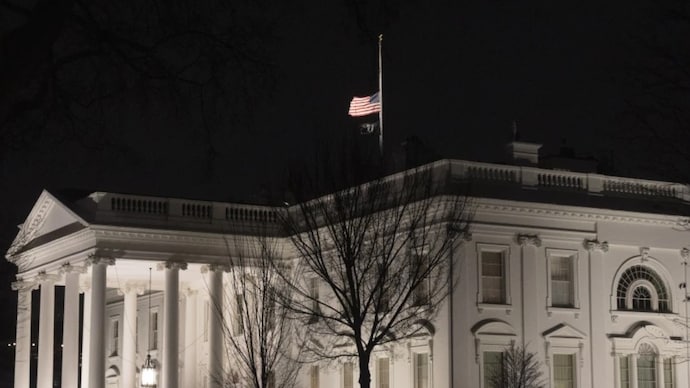
The decision to fly American flags at half-staff on Inauguration Day, a rare and symbolically charged event, has incited significant debate this year. While the practice is deeply rooted in national tradition, its concurrence with a presidential transition has transformed it into a focal point of political and cultural contention. This article examines the historical precedent, the current controversy, and the broader sociopolitical ramifications of this gesture within the context of American governance and identity.
The Tradition of Half-Staff Flags: Institutionalized Mourning
The lowering of the American flag to half-staff signifies a collective expression of mourning and respect. Codified in the United States Flag Code, this tradition outlines specific occasions for its observance, particularly following the death of a sitting or former president. The Code stipulates a 30-day period during which flags are to be flown at half-staff to honor such figures, extending across federal facilities, U.S. embassies, and military installations worldwide.
The current directive, issued by President Joe Biden, commemorates the late President Jimmy Carter, who passed away on December 29 at the age of 100. Carter’s legacy as a statesman, humanitarian, and advocate for global peace epitomizes the values that this ritual seeks to honor. Yet, the overlap with the January 20 inauguration of Donald Trump has generated an unintended juxtaposition of national mourning and democratic celebration, underscoring the tension between institutional continuity and political optics.
Symbolism and Discord: A Complex Inauguration Day
Inauguration Day traditionally embodies the ideals of renewal, unity, and the peaceful transfer of power—core tenets of American democracy. The visual dissonance created by flags at half-staff on this day, however, has sparked divergent interpretations. For Trump and his supporters, the timing of the gesture casts a pall over what should be an optimistic occasion, prompting allegations of politicization. Trump himself has publicly criticized the decision, characterizing it as a distraction and insinuating partisan motivations.
Conversely, proponents of the gesture emphasize its apolitical nature, framing it as a reflection of institutional protocol and respect for Carter’s legacy. Critics of Trump’s position argue that his reaction exemplifies a broader tendency to personalize and politicize established practices. This divergence underscores the broader challenges of navigating symbolic actions in an era marked by heightened polarization and competing narratives.
The optics of the situation further complicate matters. While Carter’s legacy as a leader defined by integrity and compassion should ideally unify the nation, the timing of this tribute has instead become a flashpoint. The debate encapsulates the broader tension between the ceremonial and the performative, illustrating how even nonpartisan traditions can become entangled in the theater of political conflict.
Mourning as a Political Arena
The ongoing controversy highlights a troubling trend: the politicization of mourning rituals. Actions such as lowering the flag are intended to transcend partisanship, fostering a sense of shared loss and collective identity. However, in the current climate, such gestures are increasingly reframed through the lens of political advantage.
This is not the first instance in which Trump has clashed with established flag-lowering practices. Following the death of Senator John McCain in 2018, Trump faced widespread criticism for his initial refusal to maintain flags at half-staff, a decision many perceived as influenced by personal animosity. The incident exemplified the fraught intersection of individual grievances and institutional customs, a dynamic that persists in the present controversy.
Carter’s passing offers an opportunity for national reflection on themes of service, humility, and bipartisanship. Yet, the contentious discourse surrounding this moment illustrates the difficulty of fostering unity in a fragmented political landscape. The symbolic resonance of the half-staff flag is thus diminished, overshadowed by the very divisions it seeks to transcend.
Navigating Protocol and Precedent: Trump’s Decision
While the U.S. Flag Code provides clear guidance, its provisions are not legally enforceable, granting the incoming president discretionary authority. Trump could, therefore, choose to raise the flags early, as historical precedent permits. Notably, in 1973, President Richard Nixon briefly raised flags to honor the return of American prisoners of war during the prescribed mourning period for President Lyndon Johnson, only to lower them again thereafter.
However, such a decision would carry significant political and symbolic implications. Deviating from established protocol might be interpreted as prioritizing optics over respect, potentially alienating both supporters and critics. Alternatively, adhering to the 30-day period could signal a willingness to honor tradition, offering a moment of decorum amidst discord.
The ramifications of Trump’s choice extend beyond the immediate controversy. His handling of this issue will likely be scrutinized as an early indicator of his administration’s approach to reconciling institutional norms with personal governance. The stakes, therefore, extend far beyond the flagpole, encompassing questions of leadership, respect, and national cohesion.
The Broader Implications: Unity in Division
The convergence of mourning and inauguration invites critical reflection on the role of tradition in a divided society. The lowering of flags for Jimmy Carter should symbolize unity and reverence. Instead, it has become a microcosm of the nation’s struggles to maintain shared symbols and rituals in the face of deepening polarization.
This moment also presents an opportunity for leadership. By adhering to the principles of respect and tradition, political leaders can demonstrate a commitment to the values that underpin the American democratic experiment. Such actions have the potential to transcend immediate controversies, reaffirming the dignity and resilience of the nation’s institutions.
As flags remain at half-staff, they serve as a dual reminder: a tribute to a statesman’s enduring legacy and a call to uphold the principles of unity, respect, and shared purpose. The manner in which this episode unfolds will leave an indelible mark on the national consciousness, shaping perceptions of both leadership and the integrity of American traditions in the years to come.