
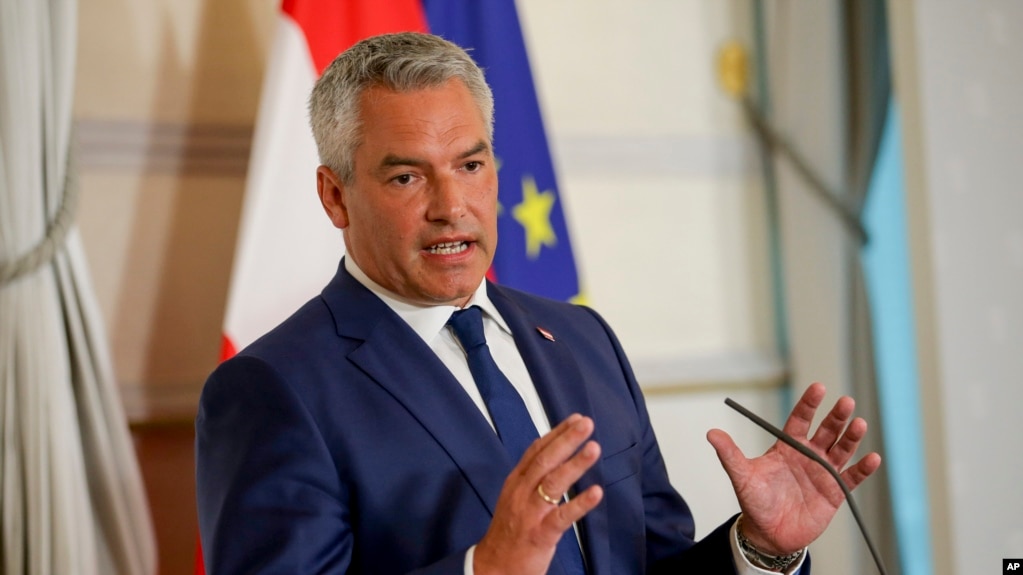
Austria's political system has encountered a profound crisis with Chancellor Karl Nehammer's announcement of his imminent resignation following the collapse of coalition negotiations. This development encapsulates the structural and ideological fragilities that permeate Austrian governance, offering a critical lens through which to analyze the interplay of political disunity, economic stagnation, and the evolving nature of leadership in contemporary democracies. The intricate dynamics surrounding this resignation reflect broader tensions within Austria's polity and invite an interrogation of its institutional resilience.
Coalition Failures as a Symptom of Systemic Malaise
The failed coalition discussions, involving the conservative People’s Party (ÖVP), the Social Democrats (SPÖ), and the liberal Neos party, underscore the entrenched ideological polarization within Austria’s political landscape. The Neos' abrupt exit from negotiations served as a catalyst for this impasse, exacerbating existing fissures between the remaining parties. Nehammer’s attribution of the breakdown to “destructive forces” within the SPÖ highlights the adversarial tenor of interparty relations.
From a systemic perspective, this failure exemplifies the limitations of Austria’s proportional representation model, which often necessitates precarious alliances. Andreas Babler, leader of the SPÖ, lamented the ÖVP's withdrawal, framing it as a dereliction of responsibility amidst urgent economic challenges. Such rhetoric underscores a recurring theme in coalition politics: the tension between ideological purity and pragmatic governance. This episode necessitates a reassessment of coalition-building mechanisms to ensure they can withstand ideological divergence without succumbing to paralysis.
Economic Pressures and Governance Deficits
Austria’s economic context further complicates its political quagmire. The nation’s budget deficit of 3.7% of GDP surpasses the European Union's threshold, while a two-year recession has exacerbated unemployment and stymied economic growth. The European Commission's call for fiscal consolidation—amounting to 18.6 billion to 24.8 billion euros—represents a formidable challenge for any incoming administration.
The inability to forge consensus on addressing these economic imperatives reflects a deeper governance deficit. Effective policymaking requires a degree of political cohesion that has proven elusive in Austria’s fragmented landscape. This predicament raises questions about the adequacy of existing institutional frameworks in managing systemic crises and sustaining public trust amidst prolonged economic uncertainty.
The Specter of Political Polarization
The tenuous parliamentary majority that a coalition between the ÖVP and SPÖ would have commanded underscores the precariousness of Austria's political architecture. Nehammer’s resignation illuminates the erosion of cooperative norms among political elites, a phenomenon that parallels broader trends in polarized democracies.
The potential recalibration of the ÖVP’s stance toward the far-right Freedom Party (FPÖ) introduces additional complexity. Herbert Kickl’s FPÖ, which shares policy alignments with the ÖVP on economic and migration issues, could emerge as a viable coalition partner under new leadership. Such an alliance would likely exacerbate societal divisions, complicating efforts to achieve national cohesion. This prospect invites critical reflection on the implications of ideological realignments for democratic stability.
Institutional Responses to Crisis: Scenarios for the Future
Nehammer's resignation sets in motion a period of political uncertainty that demands robust institutional responses. The ÖVP’s impending leadership transition presents an opportunity to recalibrate the party's strategic direction, though this process is fraught with challenges. Early elections, while theoretically feasible, are constrained by legal and logistical considerations, making them an unlikely short-term solution.
President Alexander Van der Bellen’s role in navigating this transitional period will be pivotal. His anticipated address is expected to articulate a framework for stability, yet the president's capacity to mitigate ideological discord remains uncertain. The interplay between executive authority and partisan dynamics will be instrumental in shaping Austria’s governance trajectory.
Public Sentiment and Leadership Accountability
The public response to the coalition's collapse has been characterized by disillusionment and frustration. Herbert Kickl’s critique of Nehammer, Babler, and President Van der Bellen as architects of “chaos instead of stability” resonates with a populace weary of political inertia. This sentiment underscores the imperative for leaders to demonstrate accountability and responsiveness in addressing systemic shortcomings.
Historical antecedents reveal that Austria’s coalition politics have long grappled with inherent inefficiencies. However, the current crisis accentuates the need for structural reforms that prioritize decisiveness and transparency without compromising the pluralistic values integral to democratic governance. This balance is essential for restoring public confidence and ensuring institutional legitimacy.
The Broader Implications of Nehammer’s Resignation
The resignation of Chancellor Nehammer represents a critical juncture in Austria’s political evolution. Beyond its immediate ramifications, this event offers a lens through which to examine the challenges of coalition governance in an era of ideological polarization. The onus lies on Austria’s political class to transcend parochial interests and articulate a unifying vision that addresses both economic exigencies and societal divisions.
This moment of crisis also invites reflection on the adaptability of democratic systems in the face of complexity. Austria’s ability to navigate these challenges will serve as a testament to the resilience of its institutions and the ingenuity of its leadership. As the nation confronts this watershed moment, it must prioritize inclusivity, innovation, and integrity to chart a sustainable path forward.
Conclusion: A Call for Renewed Leadership
Austria’s political turmoil, epitomized by Nehammer’s resignation, underscores the multifaceted challenges confronting contemporary democracies. The intersection of economic pressures, political fragmentation, and public discontent necessitates a reimagining of governance practices that prioritize both efficacy and equity.
As Austria embarks on this critical phase, its leaders must embrace a spirit of collaboration and accountability that transcends partisan divisions. By fostering a culture of constructive dialogue and visionary policymaking, Austria can transform this crisis into an opportunity for renewal, reinforcing its commitment to democratic principles and collective progress.