
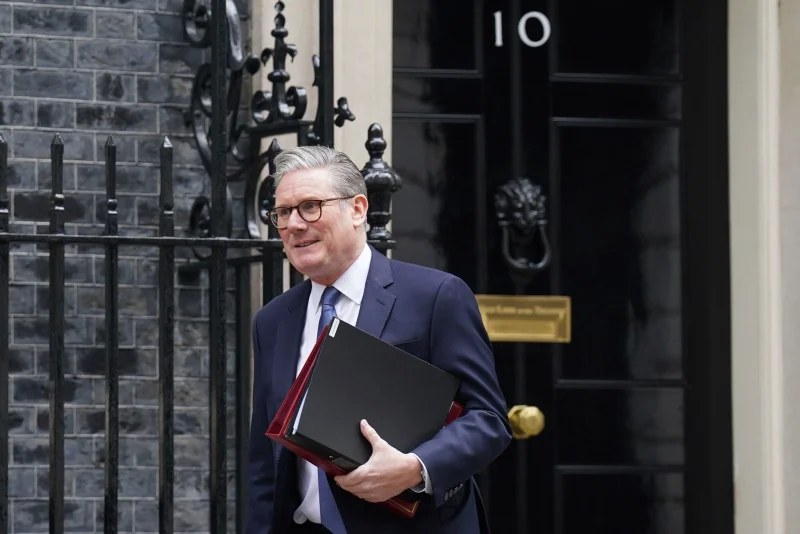
British Prime Minister Keir Starmer is once again spearheading diplomatic efforts with his so-called "coalition of the willing," a virtual gathering of international leaders meant to address Ukraine’s ongoing conflict. But as Starmer doubles down on his commitment to Ukraine, one has to wonder: is this truly a decisive move, or just another political performance with little tangible impact?
An Ambitious Effort or a Desperate Attempt?
Starmer’s initiative, which includes representatives from around 25 countries—among them European allies, Australia, Canada, and New Zealand—seeks to bolster Ukraine militarily and financially. However, glaringly absent from the coalition is the United States, which has taken a starkly different approach under President Donald Trump. The absence of the U.S., historically Ukraine’s strongest backer, raises doubts about the coalition’s effectiveness. Without Washington’s participation, can Starmer’s initiative exert real pressure on Russia?
The timing of the meeting also suggests a reactionary stance rather than a proactive strategy. The U.S. has already proposed a 30-day ceasefire, gaining tentative approval from Ukrainian President Volodymyr Zelenskyy. Meanwhile, Russian President Vladimir Putin appears to be dragging his feet, making vague acknowledgments about the possibility of peace while continuing his offensive. Starmer’s rhetoric about "straining every sinew" to pressure Russia sounds strong, but does it carry any weight in the absence of American muscle?
Trump’s Shadow and Europe’s Reality Check
One of the unspoken realities of Starmer’s coalition is that it is, in many ways, an attempt to counterbalance Trump’s wavering commitment to Ukraine. Since returning to the White House, Trump has pivoted toward a more isolationist stance, significantly changing the West’s approach to the war. This has left European nations scrambling to reassess their own defense capabilities and reliance on U.S. military aid.
French President Emmanuel Macron, who has been closely coordinating with Starmer, acknowledged the growing urgency of European self-reliance. But is this newfound European determination genuine, or merely a stopgap measure to avoid confronting the uncomfortable reality that U.S. support is no longer guaranteed? The coalition, despite its grand ambitions, may ultimately serve more as a wake-up call for European nations than a meaningful effort to end the war.
The Futility of Diplomacy Without Leverage
While Starmer’s tough talk about "Putin’s pointless games" resonates with those frustrated by the Kremlin’s maneuvering, the reality is that diplomacy without leverage is just noise. Putin has no real incentive to rush into a ceasefire, especially given Russia’s recent battlefield momentum. A coalition that lacks major enforcement mechanisms—such as stronger economic sanctions or military deterrence—will struggle to compel any real change.
Starmer has positioned himself as a leader rallying the West against Russian aggression, but without the full backing of NATO’s most influential player, his efforts may amount to little more than political theater. It is easy to make impassioned speeches about standing up to tyranny; it is much harder to enact policies that force real concessions from a ruthless adversary.
A Coalition in Name Only?
If the "coalition of the willing" is to be more than an empty gesture, it must translate words into action. This means securing stronger military commitments from European nations, enforcing tighter sanctions on Moscow, and—most importantly—convincing Washington to re-engage. Otherwise, the coalition risks becoming just another summit filled with lofty declarations and little follow-through.
As Starmer convenes his virtual assembly, the world watches with skepticism. Is this a defining moment of strategic unity, or just another well-rehearsed political maneuver? If real results don’t follow, history may remember this coalition not as a turning point in the Ukraine conflict, but as yet another example of Western leaders talking tough while failing to deliver.